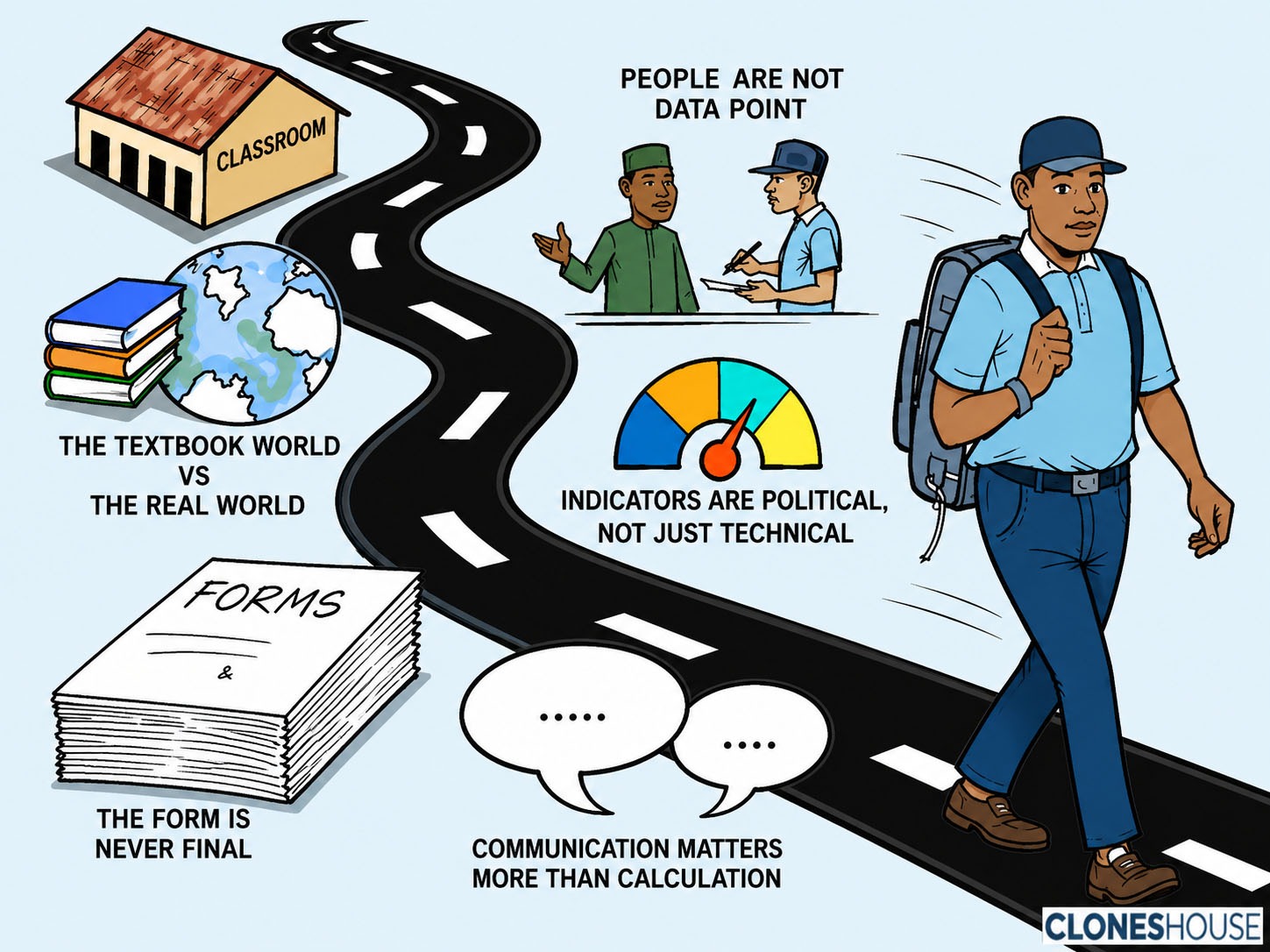
Beyond the Tools: The 5Cs Every Emerging Evaluator Needs
What a Cloneshouse Foundation webinar revealed about the human, technical, and professional competencies behind effective Monitoring and Evaluation.
In Monitoring and Evaluation, there is a familiar path many aspiring evaluators are encouraged to follow. Learn results-based frameworks. Build logframes. Develop indicators. Master data collection and analysis tools such as KoboToolbox, Excel, SPSS, and Power BI. These technical competencies matter, but they represent only part of what makes someone effective in the field.
What happens when the data is incomplete? When stakeholders resist the process? When the project design is unclear? When the evidence tells a complicated story? When the assumptions behind an intervention no longer hold? These are the moments when knowing how to operate a tool is not enough.
During a recent Cloneshouse Foundation webinar for Young and Emerging Evaluators and interns, Rachael Okoronkwo, an experienced Monitoring, Evaluation, and Programmes professional, explored what she described as the “hidden curriculum” of M&E: the practical competencies that are often developed through experience rather than taught explicitly in a classroom.
Her insights point to a simple but important conclusion: the strongest evaluator is not simply the person who knows the most tools. It is the person who knows how to think, communicate, exercise judgment, build relationships, and use those tools intelligently in complex environments.
This blog post explores the core takeaways from the session, including the 5C Evaluator Framework, and considers what it takes to survive, adapt, and thrive in the realities of modern M&E practice, while examining what it takes for emerging evaluators to navigate, adapt, and thrive in the evolving realities of modern M&E practice.
The Core Question: Are You Your Tools?
Rachael opened the session with a thought-provoking question: If you stripped away Kobo Toolbox, Excel, Power BI, and SPSS from your toolkit today, would you still know how to think and behave like an evaluator? The consensus was clear: Yes. Knowing M&E is not merely about operating data collection or analysis software; it is about having the deep technical and behavioral competence to guide an evaluation process. While anyone can learn a software program, the true value of an evaluator lies in how they handle messiness, build trust, and turn raw data into actionable decisions.
The tools may help you collect, organise, analyse, and present evidence, but they cannot decide which questions are worth asking. They cannot build trust with a community. They cannot recognise when a stakeholder’s response requires further investigation. They cannot determine whether an unexpected finding represents an error, a new insight, or a signal that the programme itself needs to be reconsidered.
Technology can support the evaluation process, but professional judgment gives that process meaning. The tools will continue to change. The evaluator must continue to develop.
The 5C Evaluator Framework

1. Curiosity: Moving from Numbers to Outcomes
Traditionally, M&E has been heavily focused on tracking output numbers, often to satisfy donor checklists. We see annual reports proudly stating, “We had given 50 pads to 50 girls in 10 schools”. However, Rachael argues that modern evaluators must move beyond “traditional M&E” to results-based M&E. Instead of just asking how many or how much, we must have the curiosity to ask: Why does it matter?
In the sanitary pad example, results-based M&E means investigating the nuances behind menstrual hygiene:
- What cultural, social, or economic factors (such as poverty, unemployment, or patriarchal/cultural norms) prevent girls from having access to menstrual or sanitary products?
- Is there a documented change in knowledge or behavior among the participants?
- Are they moving away from unsanitary practices (like using old clothes) and adopting healthier hygiene behaviors because they are now knowledgeable?
Curiosity forces us to think systematically, track outcomes, and drive real policy changes rather than just ticking boxes. A curious evaluator looks beyond the immediate number and asks what it tells us about the intervention and the people it is intended to serve. This curiosity helps evaluators explore outcomes, understand context, identify unintended effects, and generate evidence that can inform programme improvement and policy decisions. Good evaluation begins with good questions.
2. Connection: People are the Methodology
It is a common pitfall to treat M&E as a sterile, technical exercise, focusing solely on impressing the donor. In reality, people are part of the methodology, and even the most perfect design will fail if you ignore human relationships. Connection involves managing a complex web of stakeholders, including program team members, government partners, community leaders, and program participants.
Before executing any project or evaluation, an evaluator must ask:
- Who owns the data?
- Who provides it?
- Who interprets it?
- Who is missing from the room?
For instance, when entering a community, establishing connections with traditional leaders, youth leaders, and women leaders is crucial to laying a successful path for evaluation. If you discover halfway through that a critical stakeholder was missed, a connected evaluator doesn’t panic; they return to the drawing board, refine the approach, and keep the work going. The lesson is simple: people are not separate from the methodology. They are part of it.
3. Critical Judgment: Thinking on Your Toes
It was emphasized that professional, critical judgment is a core technical skill, not a soft skill, and it is built through years of field experience. When real-world crises hit, an evaluator cannot afford to panic; they must think critically and act. To illustrate this, Rachael presented a common scenario: You planned to collect 500 responses. Your deadline is tomorrow, but the backend only shows 320 entries. What do you do?
Rather than panic or blindly discard the data, an evaluator exercising critical judgment asks:
- Why are we short? Is there active resistance from the stakeholders we are supposed to collect data from?
- Would official letters of introduction help ease participant concerns?
- Do we need to align with our donor or project manager to adjust expectations?
Professional judgment is therefore not simply a “soft skill.” It is a core technical competency that develops through knowledge, experience, reflection, and exposure to real-world problems. Critical judgment means understanding the situation, considering the available options, assessing the implications, and making a defensible decision.
4. Communication: Documentation is Your Shield
In M&E, evidence lives far beyond spreadsheets and data sets. It exists in documented decisions, conversations, shifting assumptions, and detailed meeting notes. Rachael shared a vital lesson from her time at Cloneshouse: the extreme importance of meticulous note-taking. Whether you are in a high-level meeting with funders or on a call with team members, document everything.
- If a sample size had to be reduced, document why so that donors don’t hold you liable later.
- If a meeting resulted in a decision to reallocate an extra 5% of the budget to data collection, make sure that agreement is written down.
Without documented evidence, “you’re just talking”. Keeping a notepad, phone log, or paper journal is a non-negotiable habit for the today-evaluator. Communication in M&E should also include:
- translating evidence for different audiences
- managing expectations
- communicating limitations
- facilitating difficult conversations
- presenting findings clearly
- influencing decisions without overstating evidence
5. Competence: The Heart of the Work
At the center of the framework is Competence, the technical know-how of evaluation. This is the foundation that formal academic programs and training courses do teach you: results chains, indicators, logframes, and analysis methodologies. However, competence alone is not enough. It must be paired with the other four Cs to turn messy program realities into structured, actionable next steps. Competence is the foundation, while the other Cs determine how effectively that competence is applied.
Final Words: The Goal of an Evaluator

It was beautifully summarized that your ultimate goal is not simply to be the person who memorized the most M&E tools or formulas. The goal is to become the person who can walk into a messy program, ask the right questions, use critical thinking, and help people decide exactly what to do next. The tools will continue to change. New technologies will emerge. Data systems will evolve. Artificial intelligence will increasingly influence how evaluators collect, analyse, and communicate evidence.
But the need for curious, connected, thoughtful, competent, and effective evaluators will remain. So, if you are building your career in Monitoring and Evaluation, do not ask only: “What tools do I need to learn?” Also ask: “What kind of evaluator am I becoming?”
Are you ready to build your 5C toolkit? Keep learning, keep documenting, and always look beyond the numbers.
Audience Q&A: Real-World M&E Dilemmas Solved
The webinar concluded with an interactive Q&A session, tackling some of the most common bottlenecks faced by M&E and program staff today:
Q1: What is the practical difference between “Traditional M&E” and “Results-Based M&E”?
A: Traditional M&E focuses heavily on tracking inputs, activities, and immediate outputs (e.g., tracking the number of hygiene kits distributed). Results-Based M&E steps up to track the actual change, measuring shifts in knowledge, behaviors, and long-term impact within the community. The problem is not that outputs do not matter. The problem is stopping there.
Q2: What should I do if my project has no logical framework or indicators, but I need to build an M&E plan from scratch?
A: This is a very common reality. Rachel advises requesting all existing project documentation (inputs, activities, completed and ongoing outputs). Use these to start mapping out the program’s current state, then hold intentional conversations with stakeholders to define the expected changes and build the data collection tools, indicators, and analysis plans around them.
Q3: How do we get reliable data from people (like farmers) who seem untrustworthy or uncooperative?
A: Usually, a lack of cooperation stems from a lack of trust. If farmers are holding back, ask why. Are they afraid of risks or harms associated with sharing information? To solve this, go back to the “Connection” pillar. Perform proper community entry, engage their local associations or cooperative leaders to build trust, and ensure strong quality assurance. For example, use field-based photo verification or assign independent data collectors to minimize discrepancies.
Q4: How do I pivot into M&E if I don’t have a formal M&E degree?
A: Rachel’s own career journey illustrates an important point: an M&E career does not necessarily begin with an M&E degree. M&E relies heavily on transferable skills you may already have, such as communication, report writing, data analysis, and visual presentation.
- For Research Assistants: You already have experience in data collection, ethical considerations (such as confidentiality and doing no harm), and data entry.
- For Social Media Managers: You are already tracking reach and engagement analytics [40]. You can level this up to M&E by thinking about outcomes, for example, tracking if a public health post on HPV vaccination actually resulted in referrals and confirmed vaccinations.
- Next Steps: Take advantage of free or highly subsidized beginner-friendly courses (such as those hosted by Agora and UNICEF, or the Online Basic M&E – OBME course by Cloneshouse). For deep experience, look for structured internships, such as the 8-month global internship program run by Cloneshouse.
Q5: What is the difference between “M&E” and “MEAL/MEL”?
A: M&E represents the core foundations of Monitoring and Evaluation. MEAL (Monitoring, Evaluation, Accountability, and Learning) expands on this by adding Accountability (to participants, donors, and yourself) and Learning (using data-driven evidence to adapt programs and influence broader policy change).